Sunday, March 8, 2020

Address to the Dem Caucus on March 8


Dear, dear Democrats, 

When I knocked on doors and then took the oath of office to serve as your representative, I promised to push for legislation that would expand health care coverage, lift up working Maine families, support our schools, improve broadband access, and provide meaningful property tax relief. There is so much more to do but I’m really proud of the work the 129th Legislature has accomplished. Please see below for some specifics. 

I vowed to be the bridge to Augusta and have hosted informational meet and greets, written newspaper columns and letters to the editors, kept up a website and a Facebook page, and sent newsletters, electronic and paper, to help you stay aware of what’s happening at the State House. 

I am honored to serve as a Democrat and eager to keep getting our work done. I ask for your support again. You have invested in me and I hope I am re-elected so that you can see a bigger return on your investment. I’ve taken advantage of many trainings, educational trips, and informational sessions offered, working hard to be the best representative I can for you.
I am again running a Clean Elections campaign. If you are able, please support this program and donate $5 to endorse my candidacy. This is the commitment we make to keeping elections ours—to keeping democracy in the hands of the people, not wealthy donors or agenda-filled lobbyists. 

If you would like me to speak to a gathering or meet your neighbors, if you have questions I can get answered, if you have comments about what’s happening in Augusta, please let me know. 

Most sincerely,
Sarah Pebworth 

I am especially proud of elected officials working together and:
  • Raising state share of education funding to nearly 51%, which includes $115 million in new state support for local education and increasing revenue sharing to 3% in 2020 and 3.75% in 2021.
  • Eliminating single-use plastic bags and prohibiting the use of some disposable food containers.
  • Putting federal Affordable Care Act protections into state law and expanding Medicaid/MaineCare.
  • Closing a corporate tax loophole to allow funding for an increase in the Earned Income Tax Credit, a credit that puts money in the pockets of low-income workers, and expanding the Homestead
    Exemption Act and Property Tax Fairness Credit.
  • Supporting initiatives to feed more hungry school children with a program that eliminates the
    reduced-price lunch category and includes those children in the free-lunch category.
  • Establishing the Climate Change Council to assist in mitigating, preparing for, and adapting to climate change—experts and leaders are planning concrete ways to meet ambitious new statutory goals, e.g., increasing Maine’s Renewable Portfolio Standard to achieve 80% renewable energy by 2030, up from 40% today, and a goal of 100% by 2050.   
    Setting solar prices in a way that incentivizes increased distributed generation in Maine and resetting the solar metering policy to ensure consumers who produce electricity from solar will be fairly compensated for supplying excess energy back to the grid.
  • Preventing discrimination in insurance for women in Maine by requiring public and private insurers that cover prenatal care to cover the complete range of pregnancy care, including abortion.
  • Ensuring health policies provide coverage for the purchase of hearing aids.
  • Passing the pharmaceutical bill package.
  • Establishing the Innovation, Development, Economic Advancement and Business Committee, which
    worked to create a 10-year strategic plan for economic growth in Maine and instituted ways to
    address the state’s workforce shortage.
  • Supporting healthy workplaces and families by providing earned paid sick leave to more employees.
  • Recognizing the contributions of tribal communities by changing Columbus Day to Indigenous
    People’s Day.
  • Prohibiting the use of handheld phones and devices while operating a motor vehicle.
  • Establishing a Blue Ribbon Commission to modernize the way Maine funds transportation
    infrastructure in the state.
  • Establishing a way, beginning in 2022, of automatically registering eligible individuals to vote.
  • Implementing a presidential primary.
    All of this and more was done within a budget that included increasing the rainy day account. 

    Legislation we are working on this session includes:
  • Ensuring oversight and accountability of the potential transmission corridor project.
  • Passing a bond that will help fund broadband and bring affordable, equitable access to high-speed
    internet to more Mainers.
  • Exploring local ownership and control of Maine's power delivery systems (replacing CMP and Emera with a consumer-owned utility in order to refinance and control the electrical grid).
  • Adding access to comprehensive medically necessary dental care to the limited dental services
    currently available to MaineCare members 21 years of age and older.
  • Continuing to address workforce shortages and wage inequity.
  • Continuing to address tribal relations and judicial concerns.,
  • Passing the Patient First bills. 

    How cool is this?!?
    • The Maine House Democratic caucus is now 55% women, the first time in history that women have been the majority of any caucus in the Maine Legislature, and women in the House now chair 50% of the legislative committees.
    • With 12 women in the Senate, Maine has the most women legislators ever, the seventh highest number nationally.
    • Under the leadership of Governor Mills, Maine’s first female governor,
      • Women outnumber men in her cabinet, 8 to 7, for the first time ever and
      • Agriculture, Conservation and Forestry, and Inland Fisheries and Wildlife all have female commissioners for the first time.

Tuesday, March 3, 2020

Maine's Coronavirus Response


Governor Mills Convenes Coronavirus Response Team

March 2, 2020
 
Response team met today to build on Maine CDC’s work in coordinating coronavirus preparation and response to protect public health

Governor Janet Mills today convened her Coronavirus Response Team charged with coordinating State government’s response across departments and local agencies and health authorities to the potential spread of novel coronavirus, also known as COVID-19.

Maine CDC continues comprehensive planning to ensure Maine is ready should the virus affect people here and encourages Maine people to protect themselves by taking the same preventive measures that help to avoid catching a cold. These measures include:
  • Covering coughs and sneezes with a tissue and then throwing the tissue in the trash.
  • Washing your hands often with soap and water and use an alcohol-based sanitizer in between washings.
  • Avoiding close contact with people who are sick and avoiding touching your eyes, nose, and mouth with unwashed hands.
  • Staying home if you are sick.
  • Taking care of your health overall by staying current on your vaccinations, including the flu vaccine, eating well, getting a good night’s sleep, and exercising.
The response team, led by Maine CDC Director Dr. Nirav Shah, briefed Governor Mills and the Cabinet regarding measures to protect public health and safety and to prevent spread of the virus should it occur in Maine. The response team will meet regularly to share information and coordinate coronavirus preparation and response across State government. Governor Mills also participated in a briefing today by Vice President Mike Pence, U.S. Secretary of Health and Human Services Alex Azar and other federal officials for the nation’s governors about the federal government’s response to coronavirus.

Maine has no confirmed cases of COVID-19. As Maine Center for Disease Control and Prevention (Maine CDC) previously reported, one individual in Maine who met federal requirements to be tested for the virus tested negative. 

“While there are no cases of coronavirus in Maine as of today, and the risk to our state remains low, the State must be prepared to respond swiftly and effectively to any potential cases in Maine,” said Governor Mills. “The Coronavirus Response Team, led by Dr. Shah, will build on our preparation and response efforts, coordinate across state government and ensure that we are taking every precaution necessary in partnership with local health officials, hospitals, school districts, municipalities and others to make sure Maine is fully prepared and to fully inform and protect all Maine people.”

“The Maine CDC has been monitoring and preparing for COVID-19 since the virus was first identified in China in December 2019,” said Dr. Shah. “Since then, more than 30 Maine CDC staff members have been focused on protecting the health of Maine people by updating safety protocols, upgrading the state lab so that testing can soon be performed here, and working closely with hospitals, medical providers, EMS, and other partners. As we keep working to minimize the risk of community spread, the best thing Maine people can do is take common sense steps to stay healthy, such as frequent hand washing.”

In addition to Dr. Shah, the response team consists of commissioners of the Departments of Health and Human Services; Defense, Veterans and Emergency Management; Public Safety; Education; Corrections; Labor; Transportation; and Administrative and Financial Affairs. It also includes the Acting Director of the Maine Emergency Management Agency. Additional department and agency heads will participate as needed.

Maine CDC began preparedness and response efforts for COVID-19 in December 2019. The response team builds on the work that has already been done by the Maine CDC to prepare for potential cases of COVID-19. Maine CDC, which has been strengthened and revitalized over the past year under the Mills Administration, has dedicated dozens of staff to working on coronavirus preparedness and response, including:
  • adjusting emergency response protocols to adapt to COVID-19;
  • reviewing readiness plans to ensure state government maintains continuity of operations and services if COVID-19 impacts agency operations;
  • hosting educational webinars for clinicians, infection control staff, and other health care professionals;
  • 24-7 consultations with partners such as schools and public health departments to ensure they have information and resources;
  • working closely with Maine’s health care systems as they scale up preparedness efforts;
  • communicating closely with school officials including recommending that they convene their school safety teams to review and update their Emergency Operations Plans responsive to pandemic flu and reminding schools that their plans should also include provisions to ensure continuity of education in the unlikely event of a closure;
  • ensuring that potential cases will be rapidly identified and investigated and that isolation procedures are in place, if needed;
  • increasing supplies of personal protective equipment for health care workers and first responders;
  • updating lab equipment to enable testing for the coronavirus and engaging public health nurses as part of our emergency preparedness team, among other measures.
More information about COVID-19 can be found can be found on the Maine CDC’s coronavirus website, which will continue to be updated as new information becomes available.

Saturday, February 22, 2020

Legislative Update on March 1


Legislative Update: What the heck’s going on in Augusta?!
Sun., March 1 6:30pm
Blue Hill Public Library
with Sen. Louie Luchini
Senate District 7: Bar Harbor, Blue Hill, Brooklin, Brooksville, Cranberry Isles, Deer Isle, Eastbrook, Ellsworth, Franklin, Frenchboro, Hancock, Lamoine, Mount Desert, Osborn, Sedgwick, Sorrento, Southwest Harbor, Stonington, Surry, Swan’s Island, Tremont, Trenton, Waltham, and others
and Rep. Sarah Pebworth House District 133: Blue Hill, Brooklin, Brooksville, Castine, Sedgwick, and Surry 

Updates on topics including Governor’s supplemental budget, Maine’s Patients First healthcare package, and Maine’s property tax relief programs, bans on Pesticides, Election Information (where and when to vote), Consumer-Owned Utilities, and more
Time for Questions and Comments

Sunday, December 1, 2019

What does a freshman legislator do when she’s not in session?


“How can I best represent my district?” I’ve asked myself this repeatedly during the first year of my term.

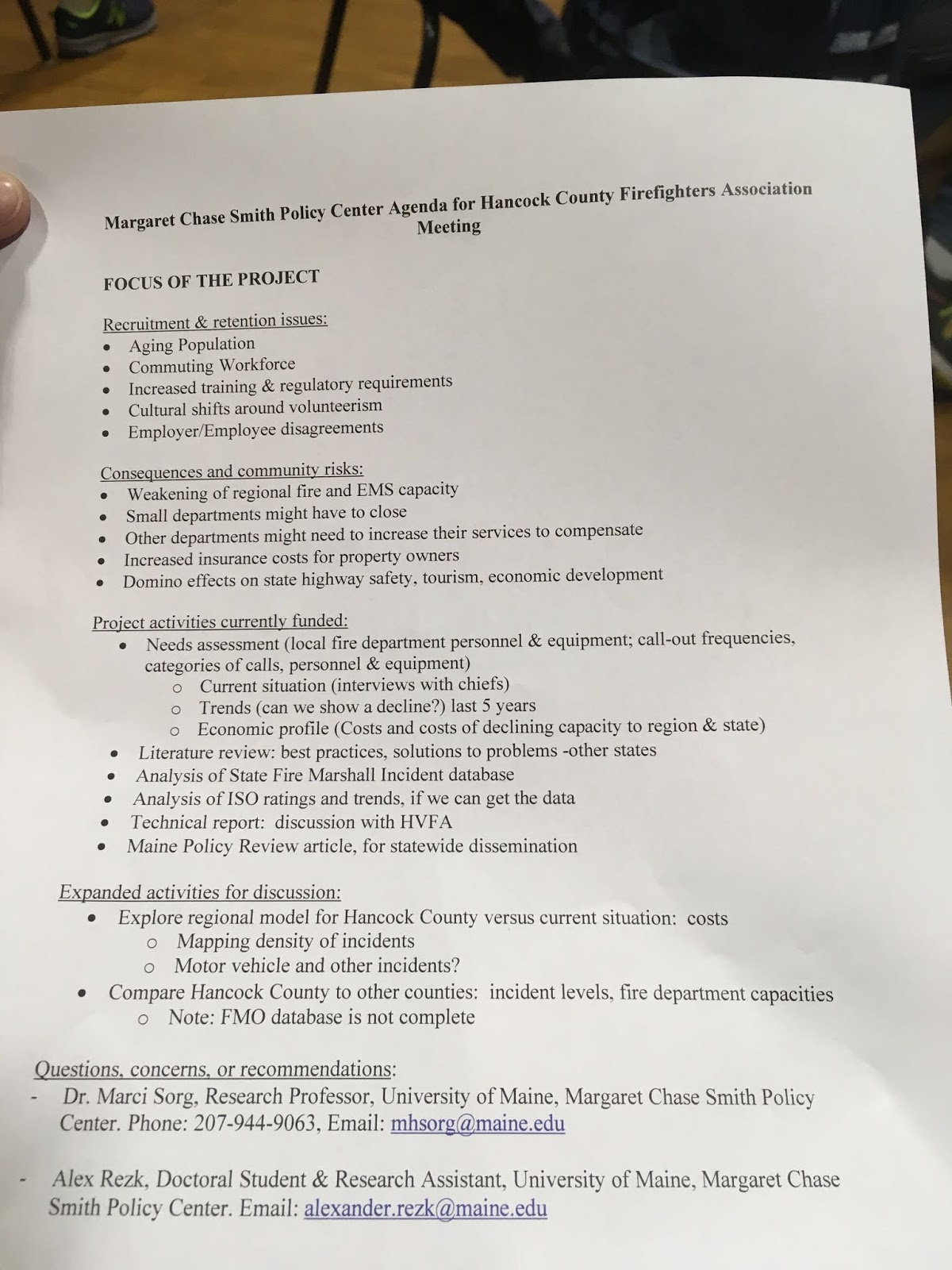
To be able to represent the interests of each of the towns in District 133, I have to understand them. To help with this, during the time when we’re not in session in Augusta, I’ve asked for or attended meetings of all sorts, throughout the district, including the Brooklin Shellfish Committee (regarding clam flats), Hancock County Firefighters Association, Surry-Blue Hill Transfer Station Committee, town of Castine, Community Compass, Department of Marine Resources meetings (regarding lobster/whale plan), Maine Maritime Academy, Brooksville municipal solar panels, Sedgwick school survey, George Stevens Academy regarding school funding, Climate Convergence Conference and follow up meetings and activities, local and state-wide responses to the opioid crisis, Maine Coast Heritage Trust (regarding alewife restoration projects), pesticide ban, Downeast Community Partners, Northern Light Maine Coast and Blue Hill Hospital, University of Maine, and restorative justice as an alternative to traditional sentencing in our justice system.

I toured the Coastal Resources of Maine recycling plant twice, before it was operational and again when it was fully up and running. 

I’ve attended a number of school classes and chatted with a local student about a project regarding women in leadership.

I’ve attended a conference on sea level rise and its financial impact and one on entrepreneurship in Maine.

I’m also working hard to be the most effective representative so have taken advantage of trainings offered, such as MakeShift coffee house and workshops on managing multiple responsibilities, building a culture of excellence and civility, and becoming a better negotiator.


But it’s not all meetings and trainings. I’ve also eaten blueberries as part of a two-day blueberry tour in Downeast Maine, and crab rolls, barbeque, and pie for various local fundraisers, and I attended Blue Hill’s Memorial Day parade and marched in the Brooklin 4th of July parade and Blue Hill’s Pride Day parade.  I participated in a fundraiser for a local children’s day camp (and won second prize in the chili cookoff—I’ll share the secret ingredients in exchange for a donation to Nichols Camp).  I helped to welcome more than 30 carpenters from around the world to Sedgwick as they helped build a blacksmith shop using just pre-industrial tools.

I’ve had conversations with constituents about financial concerns, roadways, robo calls, taxes, health care, economic development, the environment and the ERA legislation, among many other topics.

I attended a presentation by Sec. of State Dunlap regarding safety of elections (“Is your vote safe?” “Yes.”).

I am honored to represent this district—Blue Hill, Brooklin, Brooksville, Castine, Sedgwick, and Surry—and will continue to work hard to represent it well in Augusta.

As Weekly Packet Publisher Nat Barrows wrote, “Democracy works best when we all participate and when voters are informed.”

You can follow the legislative process, online at http://legislature.maine.gov or in local newspapers or radio, but if you would like to get move involved or if you have questions, concerns, or ideas for bills, contact me at Sarah.Pebworth@legislature.maine.gov.

Onward!

Friday, August 30, 2019

Special Session


Fascinating, but frustrating is how I’ve often described my work in Augusta and the latter certainly describes our special session on Monday. 

We were called back to Augusta to consider Gov. Mills’ revised bond package. We were scheduled to consider the governor’s package in June before we adjourned but the Republican caucus wanted the bonds to be considered in separate, more modest bills. The bonds were cut from $239 to $163 million and divided into 4 bills:
  • Transportation: $105 million to upgrade roads, bridges, ports, rail and air and to repair culverts and restore a commercial fishing wharf. Estimated federal matching and other funds: $137 million; passed.
  • Infrastructure and Economic Development: $15 million to expand high speed internet access in rural Maine (It is estimated that more than 83,000 households in Maine do not have access to high speed broadband). Estimated federal matching and other funds: at least a 3:1 match; $4 million for capital equipment for career and technical education centers; $4 million to restore and modernize Maine National Guard facilities. Estimated federal matching and other funds: 1:1 match; failed.
  • Wastewater Treatment and Energy Efficiency: $5 million to improve wastewater infrastructure at the municipal level to prevent and control pollution. Estimated federal matching and other funds: $12.5 million or more; $5 million to support remediation efforts through the Dept. of Environmental Protection at uncontrolled hazardous sites; $5 million for the Heating Fuels Efficiency and Weatherization Fund to provide low-interest loans for energy efficiency projects, including heat pumps for residential homeowners; failed.
  • Land Conservation: $20 million for the Land for Maine’s Future program to preserve farmland, working waterfronts, and other natural resources (to see what LMF has preserved in the past 30 years, see https://www.maine.gov/dacf/lmf/). This program hasn’t been funded in more than 8 years. Estimated federal matching and other funds: $80 million; failed.
Of particular disappointment is the loss of matching funds, many of them federal dollars, totaling more than $141.5 million, according to information from the governor’s office. Taking advantage of this money is a way to make Maine dollars go significantly farther. 

According to Maine State Treasurer Henry Beck, who advocated passing all 4 bond options, the sooner the state has the option of going to market with new bonds, the better, but now there likely won’t be any further voting on bonds until January. 

Are we being fiscally irresponsible by wanting these bonds to be put in front of Maine voters? No. The budget, which passed with strong bipartisan support, includes debt service for bonding up to $300 million and added $19.8 million to the Budget Stabilization (“Rainy Day”) Fund. This package was not the largest ever proposed, and less than the $200 million authorized by voters in 2018. Compared to other states, Maine has a modest debt profile and a strong framework for repayment.
It is especially frustrating that party-line voting will prevent the people of Maine from being able to show the Legislature their funding priorities on the ballot this November. 

We can afford to be investing in the future of Maine’s workers, land, and safety, and it is our responsibility to do so. 

You can follow the legislative process online at http://legislature.maine.gov or in local newspapers or radio, but if you would like to get move involved or if you have questions or concerns, contact me at Sarah.Pebworth@legislature.maine.gov.

Wednesday, May 8, 2019

Following a Bill on its Journey


How do you know when it’s time to pop that bottle of bubbly in celebration of a bill you care about becoming law? How can you follow the long journey of a bill? I’ll use LD (Legislative Document) 179 An Act To Change the Name of Columbus Day to Indigenous Peoples Day, because that was one of the many bills before my committee, State and Local Government, this session.

You might have read about the bill’s progress in a state newspaper: “Maine lawmakers are being asked to consider what seven states and more than 130 other cities and towns have done across the country: replace the Columbus Day holiday with Indigenous Peoples’ Day.” That was in February. 

You might have seen this post on Facebook "An Act To Change the Name of Columbus Day to Indigenous Peoples Day has passed the House, 88 to 51” in March. But clearing this legislative hurdle doesn’t mean LD 179 finished the race. 

You might have read this on a national news website shortly after that: “A bill changing Columbus Day to Indigenous People's Day in Maine is heading to the governor's desk after senators voted to approve the House-passed measure this week.” (At this point, you might also be confused as to where the apostrophe goes or if there is one!  Different news sources have different opinions.  The text of LD 179 includes no apostrophe.) 

Or perhaps you heard this on public radio: “On a roll call vote of 19-14, and with no debate, the Maine Senate gave final approval to change the Columbus Day Holiday to Indigenous Peoples Day.”

Even a website for an international television station reported that “Governor Janet Mills has already announced that she plans to sign the bill into law.”

Maybe we can start that LD 179 celebration now.

Certainly not all of the 2,200 bills we will consider this session receive—or deserve—this type of coverage.  But if you can’t find updates in the media, how can you follow a bill along its journey? 

Maine State Legislature’s website, http://legislature.maine.gov/, offers a portal to just about everything happening in Augusta. 
  • Looking like spring in Augusta
    Links to livestreaming the House or Senate when they are in session or listening in on any committee. 
  • Contact information for legislators. 
  • A calendar showing each committee meeting and the schedule of bills coming before them, whether in a public hearing or a work session.   
  • A form for searching specific bills, which leads to more detailed information about a bill’s journey—what committee it belongs to and the testimony and votes that support or oppose it.   
  • Link for submitting written testimony. 
  • A status summary showing the path a bill has taken and whether it has been signed into law.
In late April, I offered an informational meet and greet to give a guided tour of legislature.maine.gov. A number of people also spoke about their experience of being involved in state politics this session.  If you missed it and would like to attend a future meeting, please sign up for my email newsletter here.

Introducing Sarah Pebworth

I first came to Maine in 1988 and lived on Deer Isle and in Sedgwick, working at Penobscot Bay Press (PBP), waitressing at the Left Bank,...